
It would seem that all is quiet and peaceful on the market of racing EN C two-liners. There's the Ozone Photon, which people buy at any price, and there's everything else. But that's only at first glance. At second glance... the GIN GTO 3, flashing on the podiums of major competitions. The intriguing BGD Cure 3. The very interesting Niviuk Artik R2. The legendary UP is a late guest at this party, but better late than never. So, meet the UP Torre -- the first racing two-liner with the EN C label in UP's history!
Construction
Risers
Deceptively modest, which, by the way, is typical for UP. For those who want to get there rather than admire the taxi's checkers. Adjustable handles on the rear risers are UP's trademark feature -- few others have it, and it's really convenient. The brake leader line is conveniently placed too: yes, it's short, yes, it's not adjustable, yes, a pulley instead of a ceramic ring... But it all works surprisingly well and doesn't get in the way or distract you in flight. The brake handles are no-frills, semi-soft, with huge swivels and round, convenient magnets in soft rubber-like plastic. Slightly unusual kinematics: the A2A'2C4 layout, that is, two of the four A lines are moved to a separate riser branch, which, in UP's Spartan spirit, is made... of line too. Dyneema, of course, to reduce friction. All the hardware is plain steel connectors with little rubber rings to hold the lines in place. The speed system is long and strong, made of thick Dyneema. That's a hint! ;)
Lines
UP seems to be a very conservative company, but it can surprise! Surprisingly, some of the lower lines are made of Dyneema. Such lines are very durable, but usually can't boast of stable lengths. That's why it has long been good form in paraglider design to use Dyneema in the upper levels and aramid, more stable in length, at the bottom. The Torre has quite a lot of it in the lower levels, but not 100%. Seeing Dyneema going from the connectors up to the wing is a bit unusual, and even plenty of anti-UV coating doesn't fully reassure. Then again, the Torre owners I know haven't complained about length stability so far. Otherwise, the lines are just lines. The total length is about 200 meters, typical for this class of wings, the stitching is neat, nothing to pick on... well, almost. There will be one nitpick after all, but further below.
Canopy
Traditionally, a couple of words about the concertina bag. It's somehow budget. Plain materials, plain design. From the "it works, and that's fine" series. Then again, few manufacturers, even top ones, seriously bother about making good concertina bags in these difficult times.
Oh gods! UP with "ears", or rather "horns", à la Advance... oops, I mean Ozone. I understand that now, in 2026, it's not fashionable any other way, but I didn't expect such a conservative (in the good sense) outfit as UP to start playing these games too. Otherwise, we have exactly what you expect from a wing of pure German blood. A noble, smooth shape with no eye-catching features (if you don't pay attention to those "horns"). Everything is neat and tidy, like a German office on a Monday morning 10 minutes before the boss arrives. All the advanced high-tech stuffing is there, but it doesn't catch the eye. But there is something really unusual and interesting: the wing's profile. Of course, without taking our test subject apart rib by rib you can't really see it, but some things can still be noticed. The sharknose! Or rather its almost complete absence, and unexpectedly wide air intakes. Let me tell readers a terrible secret: actually, a sharknose creates extra drag. Yes, it's a reasonable price for increased "uncollapsibility" and "unstallability", but wings with such profiles can only get decent performance by sacrificing something else -- maneuverability, comfort, safety. It's not certain, but it looks very much like UP decided to go another way. Less sharknose, more performance! Otherwise, I repeat, nothing unusual. The arc, the line length, the wingtip shape. This is no BGD!
Takeoff and ground handling
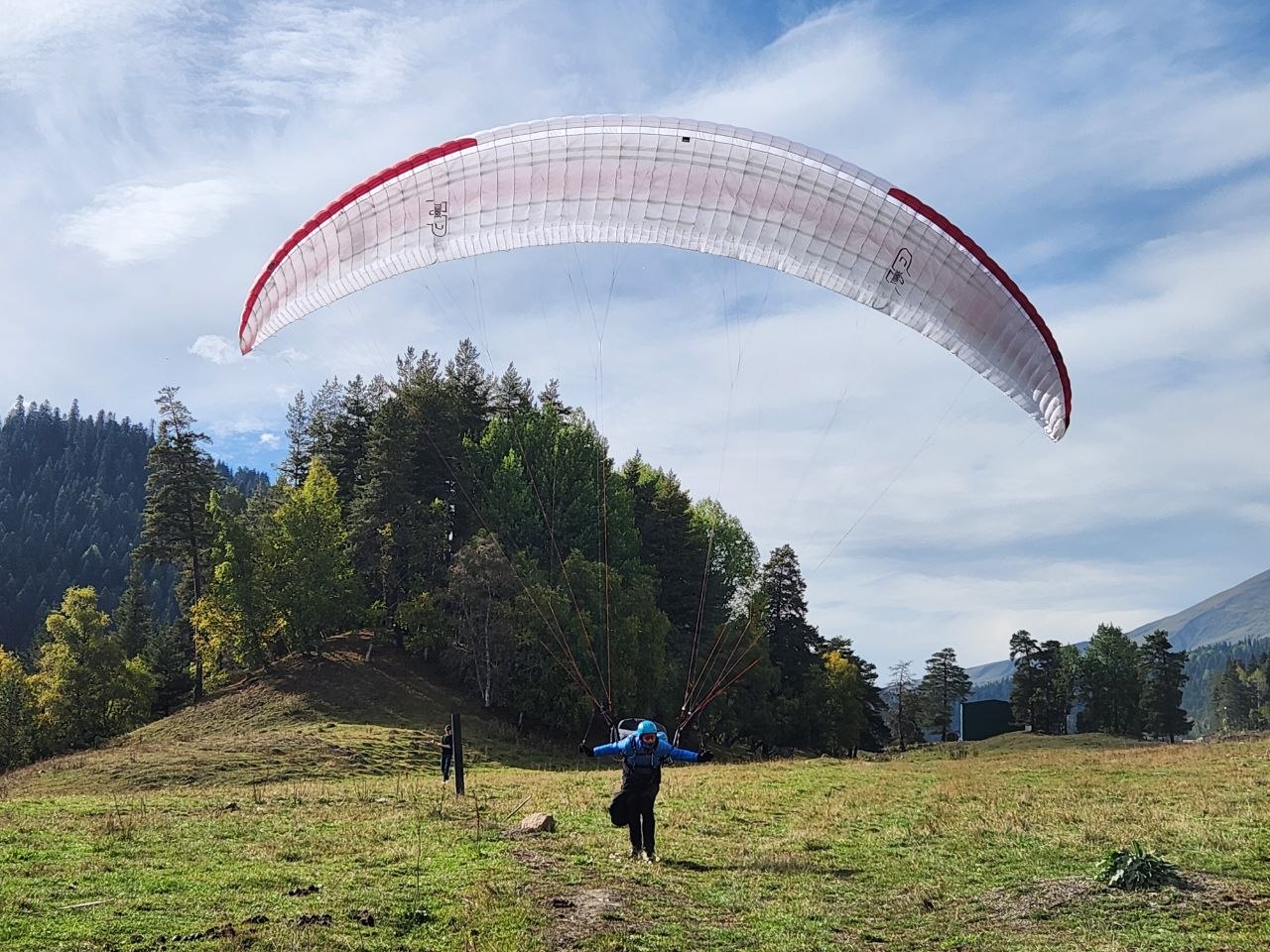
Takeoff
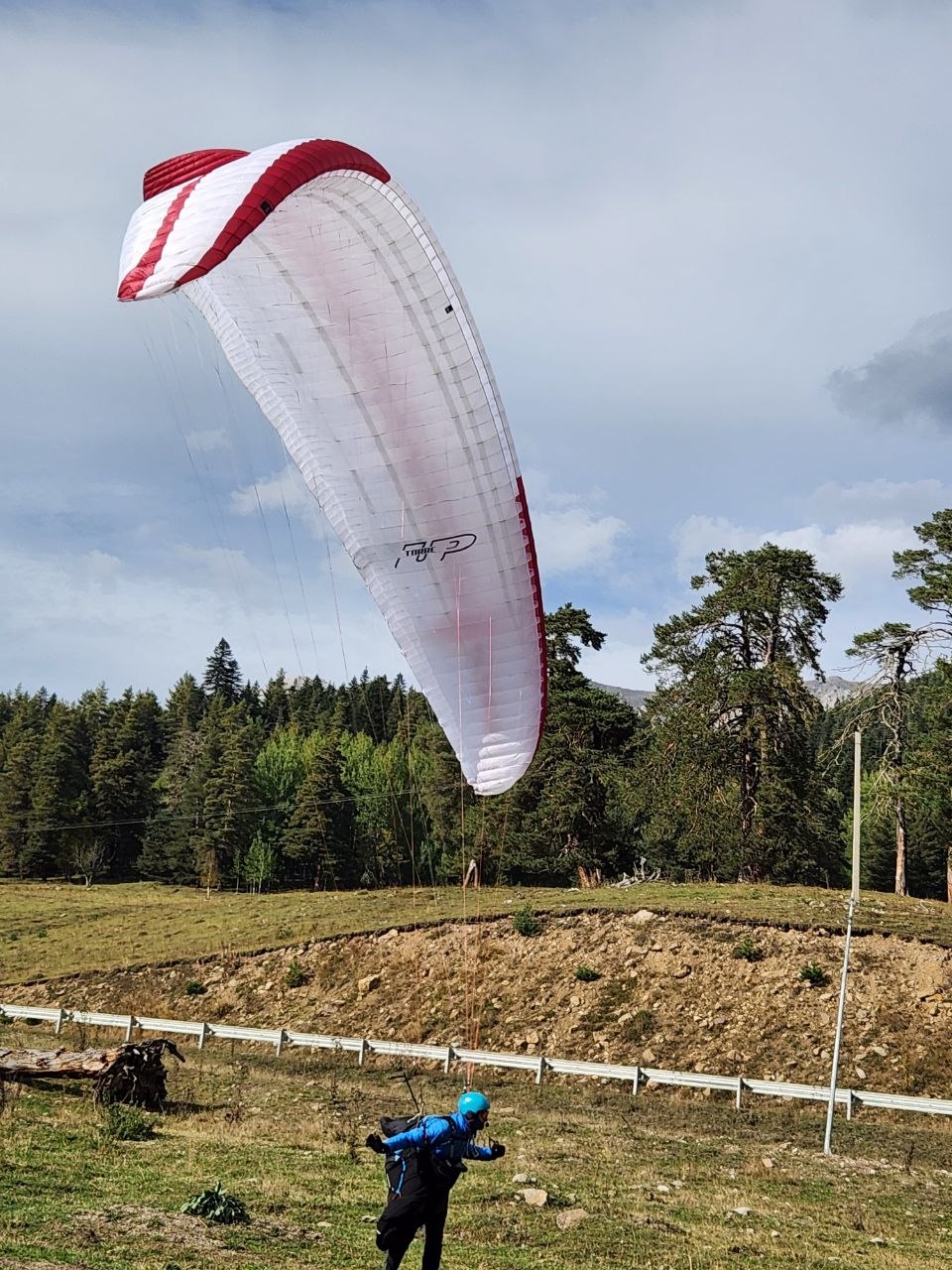
The impression depends a lot on the layout of the launch and its wind conditions. The Torre "likes" launches in moderate to strong wind most of all. In such conditions the Torre comes up overhead calmly and confidently, only starting to noticeably "shoot" in very strong wind. Technically the launch is a bit simpler than on most competition two-liners: yes, you have to load the wing properly with your body and work the front risers precisely and in measured doses -- but if the pilot does everything right, there won't be any problems. Launching in light or zero wind from small take-offs is somewhat more difficult, especially if they are fairly steep. We pull the wing by the A risers, it comes up smoothly... up... up... phew, it's up, we can fly! The run in no wind turns out to be fairly long, and that's solely because of the unhurried way the wing comes up overhead. But when and if the Torre has come up, there are no problems after that, it takes the load quickly. I was pleased with the launch in gusty wind that changed both in strength and in direction. All precise! In such conditions the Torre forgives the pilot most mistakes, sits firmly overhead and doesn't tend to jerk back and forth during the run.
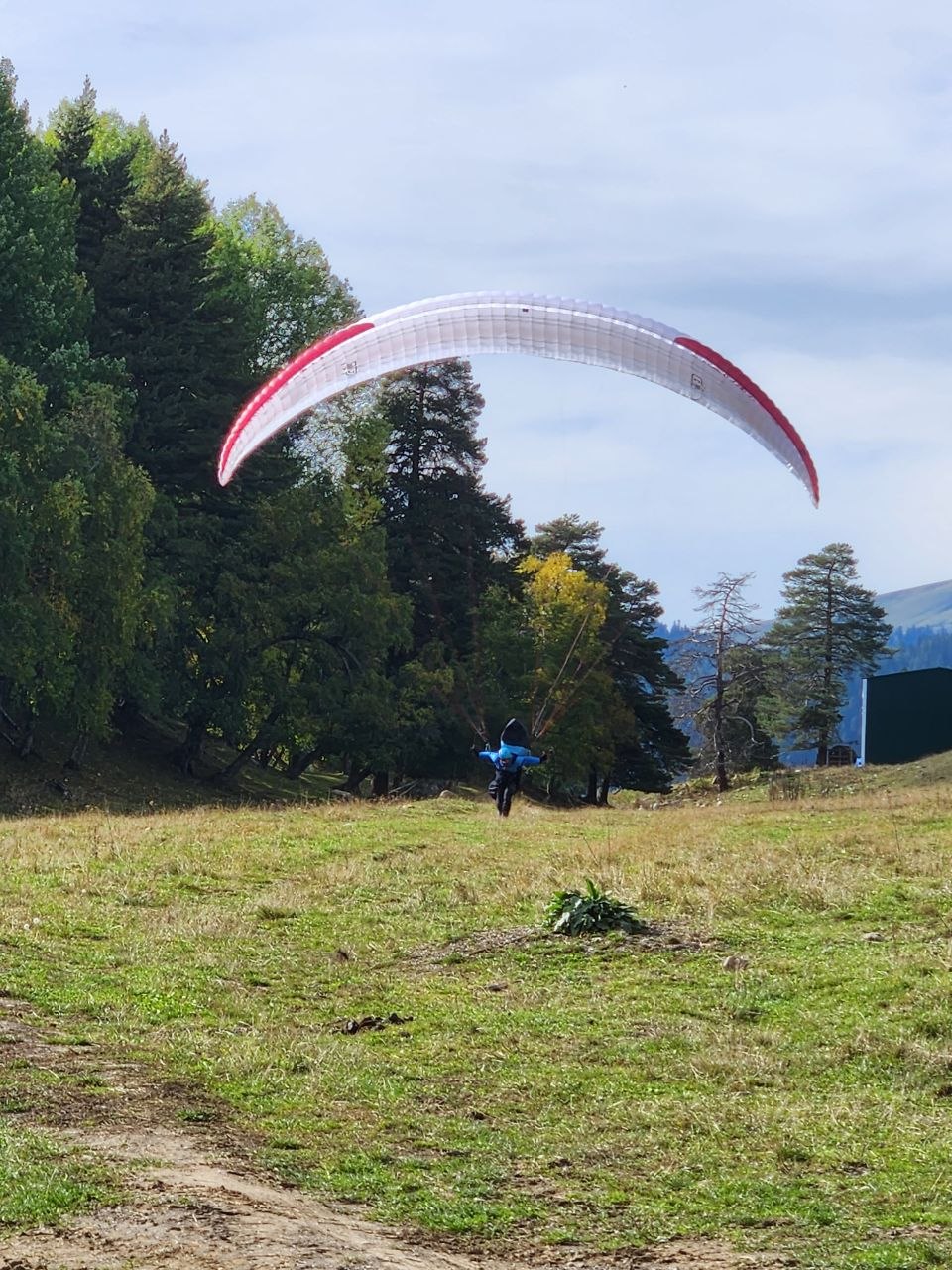
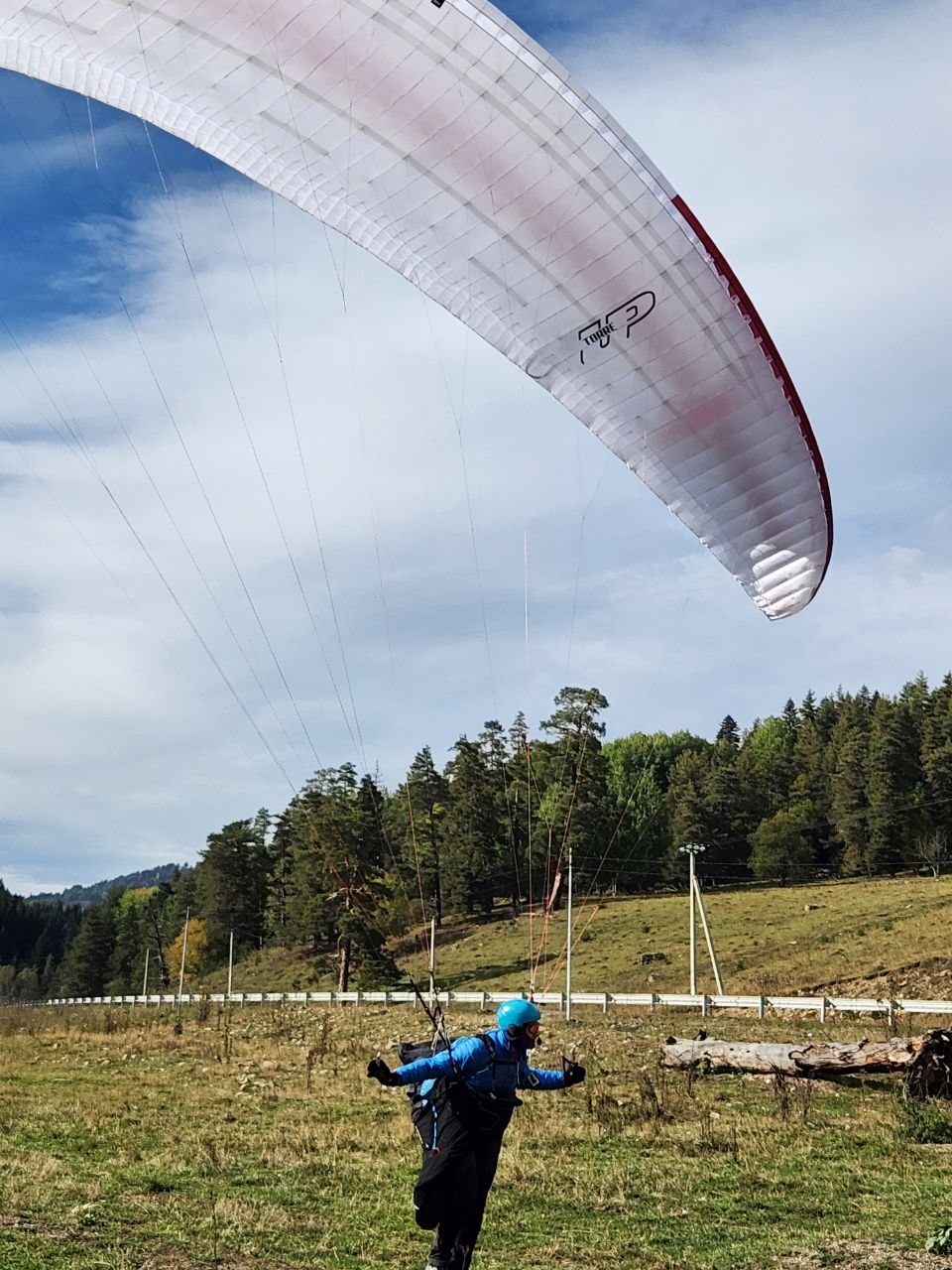
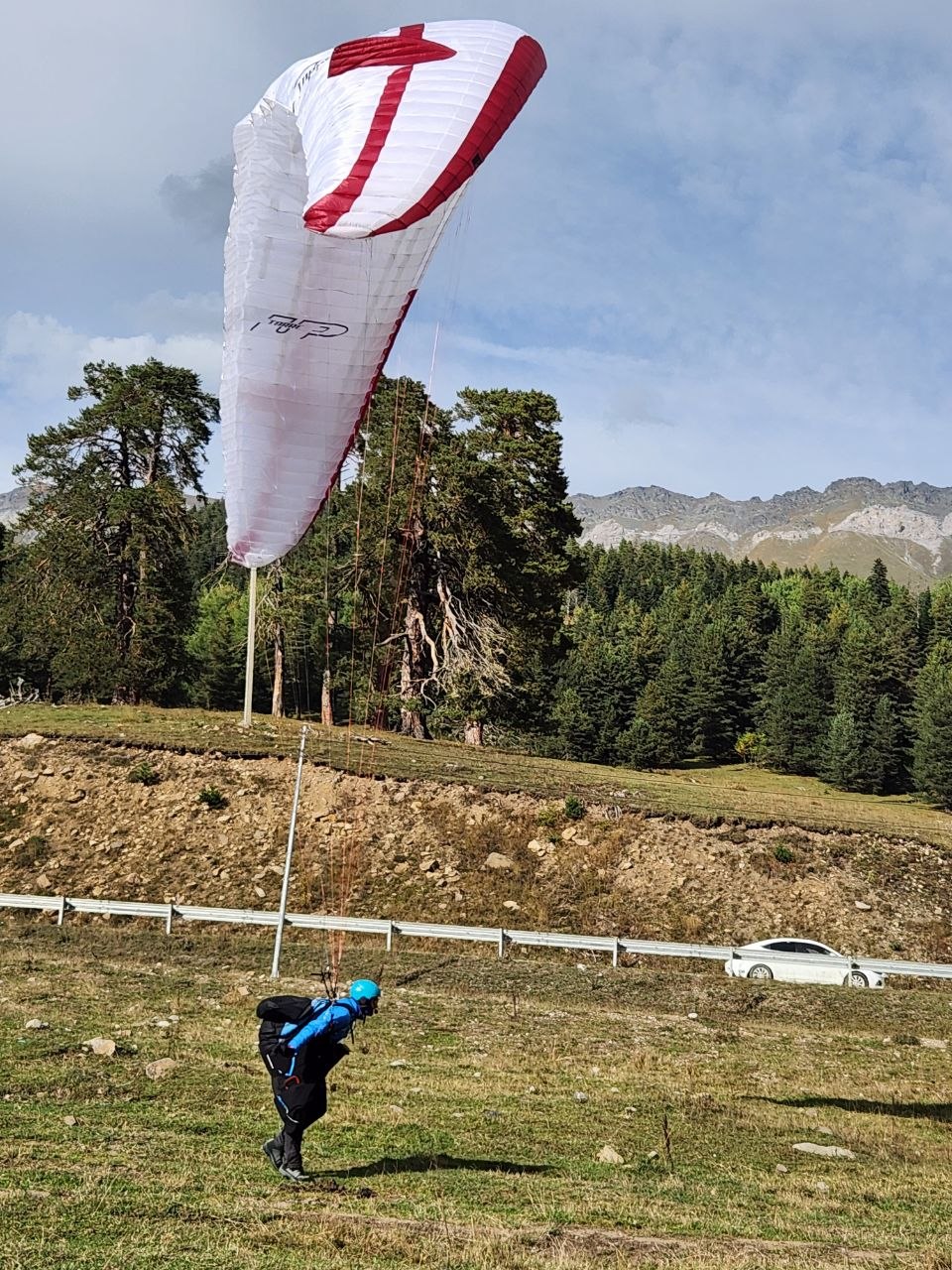
Ground handling
It so happened that almost all my launches on the Torre were in far from easy conditions. Ground handling was easier: a flat field, a steady moderate wind. The Torre clearly liked all this more than a ragged mountain breeze on a scree slope. So did I ;) In the laboratory conditions of a grass airstrip the Torre turned out calm and leisurely, yet precise in its reactions, and at the same time not demanding great skill from the pilot. It comes up smoothly, sits overhead rock-still and reacts to control precisely. The Torre starts passing the traditional test of touching the ground with an "ear" in winds from about 4 m/s -- it's not a light wing, after all. Overall -- practically a benchmark racing wing. That is, of course, I'd like a slightly quicker rise overhead and slightly less dynamics in the upper third of the rise, but demanding that from a heavy EN C two-liner would of course be too much.
Flight
Turn ability
I got to know the Torre in fairly lively mountain thermals, where maneuverability, as they say, rules. And rule it did! The Torre cored the very first thermal surprisingly easily and confidently, despite the low wing loading and kicks around +7. I was impressed by how precisely the Torre holds the bank and turn radius set by the pilot: it clings to the thermal for dear life, and even mountain turbulence can far from always change that. It feels similar to the Advance Sigma 10 -- it too sat in the thermal like it was glued in, and some modern Niviuks can do this as well. In any case, it's a very vivid and pleasant feeling. The second pleasant thing, confirmed by instrument measurements, is very compact spirals in which the Torre doesn't tend to "sink like a stone". In narrow and strong mountain thermals the Torre easily turns radii of less than 40 meters, and there is still quite a big control margin left. The control reactions... Well, it's UP! There are no hysterics, no super-sharpness that requires millimeter-precise work with your hands and body -- but there is an almost magical precision and clarity in the way the wing reacts to what the pilot does with it. Fans of wingovers right next to the slope may be recommended something hotter, but for cross-country flying it's practically ideal! The only thing I can very cautiously grumble about is the load on the hands. On the Torre it matches the efficiency of the brakes, that is, noticeably above the class average. The saving grace is that for working lively mountain thermals 30-40 centimeters of brake travel is usually enough. The load on the hands stays reasonable then, but if you want to really rock it, as they say -- be ready for your arms to start begging for mercy after a while.
A couple of words about steering with the rear risers. Taking hold of them for the first time in flight, I understood almost immediately what the Torre was made for. Heavy and moderately efficient at moderate speeds, UP's signature handles get pleasantly lighter when you push the speed bar and become very, very efficient! In terms of the combination of load and efficiency, I probably liked the Torre's rear risers even more than its brakes. This wing is clearly well optimized for flying at high speeds, and the very pleasant rear risers are only one confirmation of this hypothesis. The others will follow below.
Performance
The first thing people usually ask me after my first flight on another wing new to me is the speed gain on the speed bar. I didn't make exact measurements, but I raced plenty with the reference ParAAvis Ray2. At full speed bar the Torre expectedly outran its rival by about 2-3 km/h. The difference doesn't seem big, but in a competition race it's a difference of minutes at the finish, and in places... Depends on the level of the competition ;) I estimate the speed gain at 23-25 km/h. Not a class record, comparable to the Gin GTO3, or maybe a bit better. The Torre's glide is also very good, if not excellent: at full speed it leaves the Ray not only forward, but also upward. Again, a level of something like the GTO3, that is, leading in its class or close to it.
Comfort
A difficult question. Difficult because different pilots have different ideas of comfort. And yet my opinion matched that of another very experienced pilot, with whom we took turns flying the Torre at the same place on the same day. Overall, the Torre's behavior is well described by the word "sporty". It doesn't seem mean, it's damped quite well on all axes, but it can show its character too. On entering a narrow strong thermal, the Torre almost always makes a short and fairly sharp jump forward, and this unexpectedly contrasts with its generally fairly calm behavior. Snaking and wobbling, if present on the Torre at all, come in very modest doses. Even real mountain turbulence couldn't stir it up properly, and in autumn foothill flying and hike-and-fly the Torre hardly differed in comfort from the already mentioned Ray 2. Personally, pitch movements, even relatively sharp and unexpected ones, don't bother me much, especially if they are predictable for me; for other pilots this may not be so. But for me personally the Torre turned out to be very clear and quite predictable, and so even those pitch movements caused surprise rather than discomfort.
Feedback
Here things are simpler and more clear-cut for the Torre. Because it's UP! There is exactly as much information as should come from a wing "tuned" for aggressive competition racing on full speed bar, that is, not exactly a lot. However, it's quality that counts, not quantity ;) Everything the Torre considers necessary to tell its pilot comes not as raw data, but as carefully filtered, densely packed, high-quality analytics. You don't have to waste time and nerves analyzing what the wing "says" -- it's enough to make a decision and put it into practice. Which, as I wrote above, isn't hard on the Torre ;) At the same time, the information is delivered in a thoroughly "two-liner" way: there are delicate pulls toward the lift at its far periphery, and substantial changes of load on the brakes and the harness on entering and leaving the lift. Interestingly, the thermal "sucks" the Torre in practically to the very core; a tendency to be thrown out of the thermal, if it appears at all, shows up in those narrow and strong cores that the Torre "doesn't like", responding to them with energetic surges. Less angry thermals require a minimum of mental effort from the pilot to find and center them; physical effort, as I wrote above, is needed somewhat more.
Dynamics and energy retention
In this respect the Torre is more of a Mercedes than a BMW. Keep calm, just keep calm! It does store quite a lot of energy in maneuvers like wingovers, though, but the transitions from speed to altitude and back happen with a smoothness that looks more like slowness. And on my first attempt at a really energetic wingover, the Torre even preferred to stop somewhere around 90 degrees of bank. This is the right moment to remember that my wing loading was moderate. With a higher loading, things will surely be more fun!
Dangerous flight regimes
Spin
Interesting. The Torre's behavior in a spin depends noticeably on the pilot's previous actions and the wing's evolutions. A spin from a smooth slow spiral develops softly, involving about 40 percent of the span and giving the pilot enough time to realize what's happening and to recover. A faster and more energetic spin "on the move" (the standard way of untying "cravats" on two-liners) takes about 20-25 percent of the span and gives a quicker and more pronounced drop of the load on the inner hand. The recovery when easing up the inner brake is, as expected, instant, almost without a surge.
Quick descent techniques
Ears
Doable! In case you didn't know, that's not common on two-liners. Having the two outer A lines on a separate riser branch helps a lot. The regime is quite stable, the sink rate is decent, more than -3 m/s. The speed loss is small, although to be on the safe side it's still better to add 40-50 percent of speed bar after folding the "ears".
B-ears
In several previous tests of EN C two-liners I ran into the same problem with this regime: thin and slippery outer rear lines that try to slip out of your gloves, or cut them, or both at once. Alas, the Torre suffers from this too. No, the regime can certainly be done -- but you have to do it carefully, and not every pair of gloves will let you hold the lines reliably in this regime. But if it works out, the regime is quite stable and efficient: the sink rate with 50% speed bar is more than -3.5 m/s.
Is the Torre good or not? The answer depends a lot on what the person asking needs such a wing for, and in any case it is fairly clear-cut. As a wing for SRS competitions the Torre is very good indeed. A kind of Ozone Photon or Gin GTO3, slightly corrected and a bit extended. For cross-country flying for your own pleasure the Torre is quite good too: unlike most racing machines with the EN C label, the Torre is more agile, but, luckily, not overly informative and generally not too demanding of the pilot. That's already two in one! But adding something third to this "two-in-one" won't work: the long rods, the serious packing volume, the solid weight and the unhurried launch make the Torre not the best tool for hike-and-fly and other mountain and high-mountain adventures. In this respect the Torre is no competitor to the amazingly versatile Niviuk Artik R2, but that one doesn't fly quite as well and is a bit more demanding of the pilot: a reasonable price for versatility. But those who aren't keen on launching from scree slopes at 3000+ meters above sea level and/or carrying the wing 600+ meters up in a lightweight backpack will surely like the Torre. The entry level is about 100 hours of airtime: after all, the AR is more than 6, there are few lines, and, on the contrary, relatively much dynamics.
Pros
- High performance, suitable for EN C competitions
- High real-world passive safety
- Above-average maneuverability for the class
- Simple, clear character
Thanks
I would like to thank Roman for providing the wing for the tests.
Copyright
- Photo: I . Tarasova, D. Krasnova / UP
Technical data
| Flat area, sq. m. | 26,5 |
|---|---|
| Flat A.R. | 6,45 |
| Flat span, m | 13,1 |
| Projected area, sq. m. | 22,8 |
| Projected A.R. | 4,96 |
| Projected span, m | 10,6 |
| Cells, total | 67 |
| Lines length, m | 220 |
| Lines scheme | A2A'2C4 |
| Takeoff weight, kg | 95-115 |
| Glider weight, kg | 5,3 |
| Size | L |
Materials and components
| Manufacturer | Material | |
|---|---|---|
| Upper surface, leading edge | Dominico | D30 / D20 |
| Upper surface except leading edge | Dominico | D30 / D20 |
| Bottom surface | Dominico | D20 |
| Ribs, supported | Porcher / Dominico | Skytex 40 Hard / D32 Hard |
| Ribs, unsupported | Porcher / Dominico | Skytex 40 Hard / D32 Hard |
| Lines, upper cascades | Liros | DC |
| Lines, middle cascades | Liros / Edelrid | DC / 8001 |
| Lines, main (lower) cascades | Liros / Edelrid | DC / 8001 |
| Lines, brakes | Cousin / Liros / Edelrid | 989 / DC / 8001 |